Refrigerator Repair
Sub-Zero Refrigerator Not Cooling: Causes From Simple to Serious
A refrigerator that is not cooling usually has a simple cause first: a changed set point, blocked vents, a dusty condenser or a leaking door gasket. Check those yourself, then listen to the fans, and book a diagnosis if the cabinet stays above 40°F.
If your refrigerator is not cooling, work from the cheap causes toward the costly ones. Confirm the display reads 38°F for the fresh-food section and 0°F for the freezer, clear anything crowding the grille and the inside vents, vacuum the condenser, and make sure the door gasket grips all the way round. Give each fix several hours to show results. Still above 40°F after that, with the compressor humming away? Then a fan motor, the defrost circuit or the sealed system is the likely culprit, and it is time to stop and book a diagnosis.
That order matters more on a built-in than on a freestanding fridge. A Sub-Zero, Thermador or Miele column sits flush in cabinetry, breathes through a single grille and offers no back panel you can reach, so small airflow problems show up sooner. In plenty of older Winchester houses the refrigerator lives in a narrow butler’s pantry or a rear kitchen remodelled around it, so a grille crowded by new trim is worth ruling out early.
Check the settings before anything else
Start at the control panel, because the cheapest repair is a button somebody pressed. Children, cleaners and a bumped touch pad can all nudge a set point up a few degrees unnoticed. Put both sections back at 38°F and 0°F. Look for a showroom or demo mode too: on some electronic controls it keeps the lights and display running while the compressor stays off, which looks exactly like a dead refrigerator. If the panel shows a code, write it down before resetting anything; our notes on reading Sub-Zero error codes explain what the common ones point to.
Then stand an appliance thermometer in a cup of water near the centre of the fridge and check it the next morning. The readout tells you what the control is asking for; the cup tells you what the food is actually getting.
Clear the airflow, inside and out
A refrigerator pumps heat from its interior into the room, and it needs open air at both ends to manage that. Inside, cold air leaves through vents on the back wall or ceiling of each section. A tray of leftovers or a tall bottle pressed against those openings starves the shelves below, so pull a few items forward and leave a finger’s width of space around the vents.
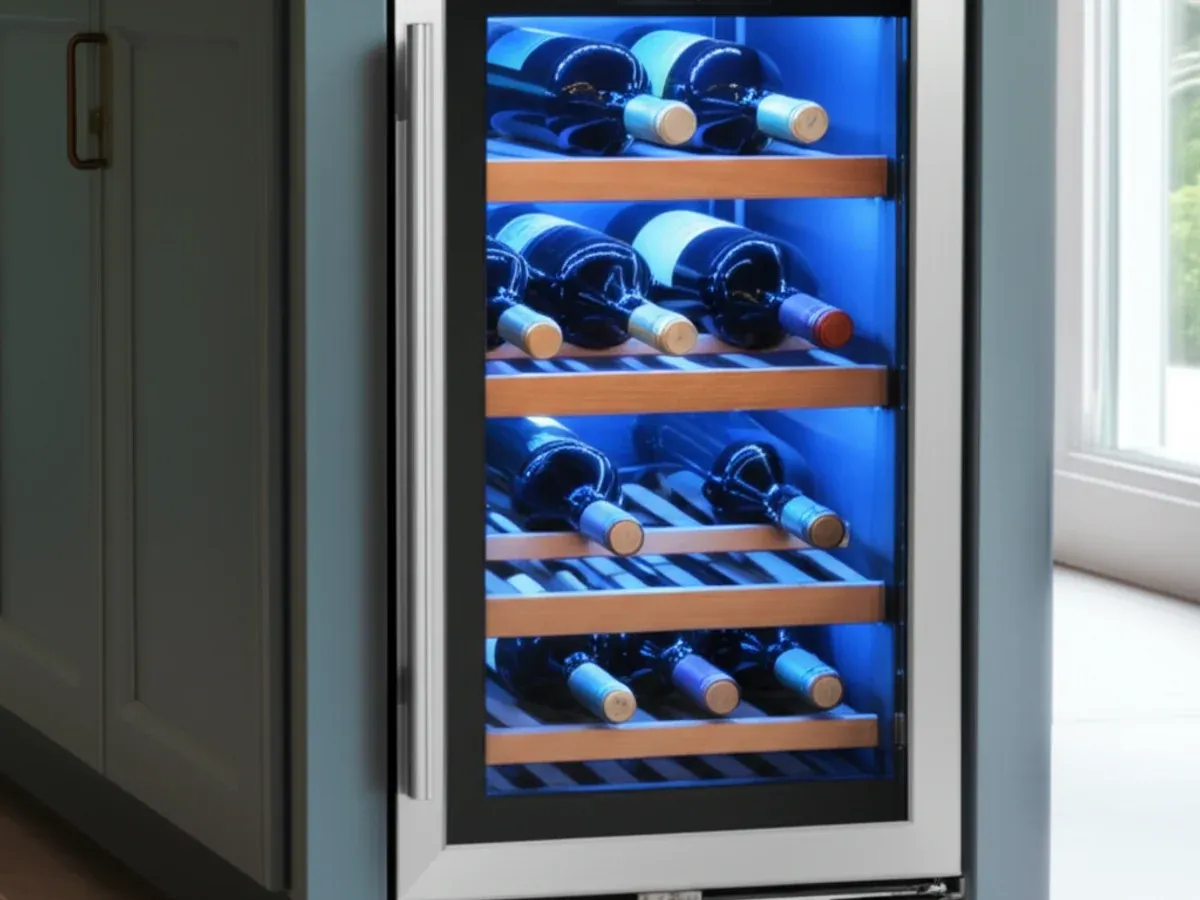
Outside, the condenser is the coil that sheds the heat. On most classic built-ins it sits behind the grille at the top; on many undercounter refrigerators and wine units it hides behind the toe kick. With the power off at the breaker or the unit’s own switch, remove the grille and look. A grey felt of dust or pet hair on the fins works like a blanket: the compressor runs longer, and the cabinet creeps warmer week by week. A soft brush and a vacuum crevice tool will clear it. Work along the fins rather than across them, since they bend easily. Twice a year is a sensible habit.
Past the point of checking it yourself?
Test the door gasket and how the door closes
A door that does not seal lets warm, humid kitchen air in all day, and the refrigerator can never catch up. Trap a sheet of paper in the shut door at the hinge side, the handle side, the top and the bottom, then tug it free; each pull should meet firm resistance. Paper that slips out easily, a gasket that is torn, flattened or stiff, or a door that drifts open instead of pulling itself shut all point to the seal or the hinge. Wipe the gasket with warm soapy water first, because a sticky film can hold it off the frame. Frost along the door edge inside the freezer is another sign of a leak, and so is an overfilled door bin that keeps the door a fraction open.
Loud and not cooling: fans and the defrost system
Noise and warmth together usually narrow the search. Many refrigerators pause the inside fan while the door is open, so press the door switch with a finger and listen. A fan that squeals, grinds or ticks against ice is failing or obstructed. Behind the grille, the condenser fan should spin whenever the compressor runs; if the compressor hums and that fan sits still, the coil overheats and cooling falls away.
Now look at the freezer’s back panel. A thick white coat of frost there means the automatic defrost has stopped working. Ice chokes the airflow, and in a refrigerator that feeds the fresh-food side from the freezer, the fridge warms first while the freezer still feels cold. A manual defrost, with the unit off and the doors open for a day over towels, can buy time, but the frost returns until the heater, thermostat or sensor is replaced.
The serious end: compressor and sealed system
If the settings are right, the condenser is clean, the door seals, the fans run and there is no wall of frost, the fault probably sits in the sealed system: the compressor, the refrigerant and the tubing that carries it. Signs include a compressor that never stops while the cabinet stays warm, frost on only part of the evaporator, a new hiss or gurgle, or an oily stain near the tubing. On a built-in with dual refrigeration, one warm section and one normal one tells a technician which system to test first. This is regulated work needing specialist equipment, never a homeowner job.
Where to stop, and what repairs typically cost
Stop once you have checked the settings, vents, condenser and seal. Removing interior panels, probing wiring or touching the compressor is where an owner risks a shock, cut fingers or a larger bill.
Typical ranges for the parts these faults lead to: a door gasket or seal at $290–$760, an evaporator or condenser fan motor at $320–$650, a defrost heater, thermostat or sensor at $280–$680, an electronic control board at $480–$920, and compressor or sealed-system work at $1,000–$2,330. The firm figure comes only after diagnosis. Every visit begins with a $95 charge that pays for the trip and the complete fault-finding, and that amount is taken off the repair when you decide to go ahead. Our page on built-in refrigerator repair describes the visit, and we cover Winchester Center, Symmes Corner, Woburn and Arlington. Call (781) 675-1098 to arrange a time.
Still asked on the phone
How long does a refrigerator take to get cold again after a fix?
Expect several hours before the shelves feel cold and up to a day before both sections settle at their set points. A built-in packed with warm food takes longer, so keep the doors closed and hold off on a big grocery load until a thermometer in a glass of water reads under 40°F.
Why is my freezer cold but the refrigerator section warm?
On many refrigerators the fresh-food side is cooled with air borrowed from the freezer, so a frosted coil, a stalled fan or a blocked duct warms the fridge first. On a built-in with a separate system for each section, a warm refrigerator side points to that section's own fan, defrost parts or sealed system.
Can I clean the condenser on a built-in refrigerator myself?
Yes, most owners can, as long as the power is off first. Lift away the grille at the top or the toe kick, then brush and vacuum along the fins with a soft brush and a crevice tool. Never spray water into the compartment or pry at bent fins, and leave the fan and wiring alone.
Is a compressor repair worth it on a built-in refrigerator?
Often it is, because sealed-system work typically runs $1,000–$2,330, while a comparable built-in refrigerator, appliance only, typically costs $8,270–$19,510 before panels and installation. The age of the unit, the state of the cabinet and what the diagnosis finds all matter, so the firm quote follows the inspection.
Is the food safe if my refrigerator stopped cooling overnight?
Check a thermometer before deciding: perishable food that has sat above 40°F for more than two hours should be thrown out. A closed refrigerator generally keeps food cold for about four hours with no cooling, and a full freezer holds for roughly two days, so keep the doors shut while you troubleshoot.